Sunday, April 22, 2012

The Rolling Scones: Vanilla Walnut Edition

Scones are a traditional breakfast food in our family. Easter, Memorial day, Birthdays, Christmas, Wimbledon, my parents will find any excuse to bake some yummy treats in the morning. And since scones taste almost as good the next day as they do fresh from the oven, they're perfect when you bake enough to last the rest of the week. We tried a new recipe recently, and to be honest I'm sold on this protein-packed variation.

Now don't be afraid to turn on your ovens, pour a cuppa tea or coffee, and take your breakfast out on your patio for a truly original breakfast experience.


Vanilla Walnut Scones

2 cups all-purpose flour
1 tablespoon baking powder
1/2 teaspoon salt
1/3 cup unsalted butter, diced
1/3 cup heavy whipping cream + little extra for brushing
1 egg
1/2 cup granulated sugar
2 teaspoons vanilla extract
1/4 teaspoon maple extract (We had none on hand, so I used walnut extract)
1 cup walnuts, toasted and chopped

Preheat oven to 425 degrees F. and line a cookie sheet with parchment paper.

In a bowl whisk together, the flour, baking powder, and salt making sure they are well combined.

Using a pastry blender cut the butter into the dry ingredients until you have you have a fine crumb texture.

In case you don't know what a pastry blender is...

Add the remaining ingredients into the bowl and stir until the dough comes together.

There are two ways to shape the scones, in wedges or in round, homestyle biscuit-like mounds (think of the typical Bisquick strawberry shortcakes). While the biscuits are more rustic, I prefer the triangular wedges because they are easier to store in our square Tupperware containers. To shape them, roll the dough into the shape of a disc about 8-9 inches in diameter, then slice it into 8 wedges.

Place the wedges onto the lined cookie sheet, lightly brush the scones with the extra heavy cream and sprinkle the tops liberally with sugar. (As you can see in the pictures, I prefer sugar in the raw on top of my scones. It adds extra texture to an already aesthetically pleasing countenance. However, if you don't happen to keep this natural brown sugar on hand, use whatever you have.)

Bake about 10-12 minutes or until golden brown. Serve them warm or let them cool on a wire rack and store. Pop them in the toaster to reheat and crispetize them!

Optional: Top with raspberry jam and a dollop of whipped cream. My mom prefers lemon curd and clotted cream. Deeeelicious!

Sunday, November 27, 2011

Fables and Morality

I just realized that my entire sense of morality is based exclusively upon a bunch of insane, illogical fables and fairy tales that I heard whilst growing up. Some of these might explain why we are so screwed as a generation.

The tortoise and the hare

This is the epic story of some sort of bizarre animal Olympics in which a turtle and a rabbit are racing each other. Everybody expects the rabbit to win, but the shit hits the fan when he decides to take a nap right before the finish line. The turtle eventually passes him and crosses the finish line first, winning the respect of the entire animal kingdom and establishing turtles as one of the fastest land animals around. Moral: I think the moral of this story is supposed to be that slow and steady wins the race, but the only reason the turtle wins is because the rabbit took a fucking nap. There is no way to apply this to real life.

The boy who cried wolf


When a village discovers that their sheep are endangered of being eaten by a wolf, they make the decision to have the precocious, wise-cracking town trouble-maker guard them. Ever the comedian, this kid thinks that it would be a hilarious gag to say that there is a wolf when there really isn’t. Although he is proven correct, the town becomes pissed off at him, especially when he does it a second time. Since this town is full of incompetent idiots, they elect to continue employing this cruel, completely unreliable wretch as their sheep-watcher. The twist is this: When a wolf really does come, nobody listens to the boy, because they think he is up to his old tricks. In the version I’m accustomed to, the wolf is content with just eating the sheep, but I was recently informed that the boy also gets eaten, which was very sad to me, and made me cry for two days.
Moral: If you don’t tell the truth, you will probably die. Also, it might be a good idea to run a quick background check on who you hire to safeguard your town from wolves.

The three little pigs

There’s a wolf cavorting around pigtown, and he wants some bacon. Since most wolves have the magical ability to blow down buildings, this wolf decides to blow down a bunch of pigs’ houses (I don’t know why these pigs are living in houses). One of the pigs is autistic, and he makes his house out of straw, while another pig makes his out of wood, because I guess he wants to live in a cabin. The wolf blows both of these houses down, but he can’t blow down the third pig’s home, because he has built his out of bricks.
Moral: If your house is in jeopardy of being blown down by a wolf, you should probably hire somebody to be on the lookout, or at least hire a contractor to reinforce the walls in your home. To avoid further problems, please refer to the previous story.

Thursday, October 27, 2011

Bees are scary.

OK, here’s how stupid bees are: they kill themselves just to piss you off. Think about it. . . . If you were a bee, would you commit suicide simply to sting somebody? I mean, all it would do is give them a momentary feeling of discomfort. Meanwhile, you, the bee, would die slowly and painfully. You know, if I was a bee, I think I’d just scare people a little, like by going in their hair, or landing on their arm. Just to teach them not to go near me when I’m pollinating a flower. Hey, I need my privacy.

Now I don’t mean to come off so “anti-bee” here, but it’s just that I’ve been stung one too many times. Bees can be alright, when they’re chillin’ in their hives and making me a jar of honey. But when they go into your car and sting you? I’m sorry, that’s not cool.

Sunday, August 21, 2011

Oral History Abroad: The Youth of Belfast

Ireland has been terrorized for the past century by political separatists, the Irish Republican Army, and guerilla warfare. Though the direct combat has died down since the turn of the century, the danger still remains and is prevalent in the everyday lives of Irish citizens. Religous warfare and political terrorism manifest themselves annually during riots that are widely publicized around the globe. Racial relations have taken a back seat in Northern Ireland as segregation based on religion increased in frequency. For William, a 21 year old Catholic student living in Belfast, having diverse opinions can be dangerous. William's life was shaped by his cultural upbringing in the Belfast area, his social interactions with peers, and the history of the warfare in Belfast.

William was born in the district of Glengormly, in the Greater Belfast area. Looking back, William thought it was a nice area to grow up, yet the people had different mindsets from his own. Glengormly is a very sports-oriented small town where everyone followed Gaelic League football that William was less than interested in as a child. Around the age of 10, William had a selectively small group of friends who were also not included in the football craze. When he was old enough, William decided to leave Glengormly and the sports oriented people behind and retreated into a secluded world of video games and movies.

To further distance himself from his fellow townspeople, William looked forward to grade school, which in Belfast is composed of the seven years of primary school and seven years of secondary school. In Ireland, students are divided into classes based on their proficiency in certain subjects. William's class, however, was separated by age and last name. His core classes, such as english and mathematics, were taken with the form class, the original people he was lumped together with at the start of the first year. Unfortunately, William was placed in a class with a group of other students who were not interested in learning. This was the only year this system applied to. The following year, the school administration realised their mistake and reinstated the old system for future classes. William's class was rated the worst in his school for ten years, but during the final two years, as the college years approached, the mood of his class changed. Students were finally interested in learning, non-sports extra-curricular activities were offered, and William thoroughly enjoyed the topics he learned about. In fact, when his class participated in a mini-business venture as a project, they won the Northern Irish regional competition and were invited to participate in the main event in the Savoy Hotel, London. He described the venture as selling "random stuff, having a laugh doing it, and raising £400." Half of their profits were donated to charity.

After graduating from secondary school, William felt immense pressure to attend a university immediately. According to a study by the Minister of Employment and Learning, Sir Reg Empley, Northern Ireland has the highest participation rate in higher education in the United Kingdom (2010). This statistic can be explained using William's expereince during his final year. Secondary schools pressure all of their students to gain acceptance to a university immediately after graduation to raise their status. It is marketed as the logical next step in education, and William did not want to deviate from that social norm. Additionally, William didn't think he could afford to take a year off before continuing at a university. Most of the jobs available require experience. Experience is learned with higher education. Higher education required money, and William had very little. According to William, he chose to the wrong university first and then took a half year off to recollect his thoughts and spent the time working full time at a supermarket. Even though William has returned to school, part of him thinks its a waste of time. During his time between univeristies, William developed a back-up plan to open a cafe in downtown Belfast. In his own words, "a degree in biological sciences won't get me a job and I now have about £18,000 of debt." Robin Wilson, who wrote an article on the student debt for the Chronicle of Higher Education, a vast majority of college students feel the same sense of hopelessness about their debt situations. Most college students do not, in fact, borrow much money to pay for their college education. Only one third of college graduates leave with no debt at all, and 65% of graduates will owe upwards of $20,000 (Wilson, 2009). Sometimes, William thinks his choice to attend the university was a mistake. "I just continually think about saving up and opening a business so I could have started earlier on that. However if I hadn't went (sic), I wouldn't have met the most interesting people, had the random experiences and generally arsed around that led me to come up with my awesome business idea."

When William moved from Glengormly to Belfast city, he made the transition with ease. However there was a strict line dividing the natives of Belfast from the rest of Northern Ireland. Since Glengormly is only a fifteen minute bus ride from the center of Belfast, William posessed the modern Belfast accent. Just beyond Glengormly, the accent drastically changes and those residents of Northern Ireland are known as "culchies." These "out of towners" stand out in a crowd and are generally not respected by the citizens of Belfast. They are, in a sense, the "rednecks" of Northern Ireland.

William experienced religious oppression when he was still in his teens. He was hanging out with a group of friends when he met a young woman. From the instant they met, they were inseparable. For two years their freindship blossomed into a young romance. Unfortunately for William, this young lady's father did not approve of their friendship. In the police database, certain areas of Northern Ireland are blacklisted as the most dangerous for police officers. Her father was a high-ranking police officer, and their Protestant family was accustomed to living in a rather rich neighborhood. William happened to live next door to one of those highly Catholic blacklisted areas. Previously, when violent riots occurred rather often, there were a great number of police officers killed in the line of duty. For the safety of her family, William and his girlfriend agreed to stop seeing one another. While this may have seemed unfair at the time, William now recognizes the danger of the situation and is thankful that his girl friend's family would not be in danger because of his actions.

In the Belfast area, one Protestant tradition is marching in the Orange parades. Not all Protestants participate, though even a small amount will cause public outcry. The Orange Order was originally established to suppress the Catholics. One area was called Ardoyne, where the orange men always march, and unfortunately, is extremely Catholic. William further explains: "Riots traditionally break out most years, but this year was particularly bad. Some kids, kids being the operative word here, dropped a breeze block on a police woman's head and nearly killed her." The riot began in Northern Belfast on July 12 and continued for three days. The news confirmed that the police woman was in stable condition in the morning. Children as young as 8 years old were videotaped participating in the violence. The Orange Order rejected a new route proposed by groups attempting to mediate during the annual march, and William plans to avoid the blacklisted areas during that time.

Religious prejudice is not just located in the urban areas but has permeated the Irish culture right down to the pubs. Though some pubs are separated by political factions of the religious groups, two have polarized businesses in Belfast. The Republicans are typically Catholic followers and would prefer Norther Ireland to separate from Britain and return to the political unit of Ireland. Unionists, on the other side of the spectrum, are typically Protestant and want to keep the link with England. William has noticed that in certain areas where the beliefs are very strong in one way or the other, the bars tend to be marketed toward that group. However, the vast majority of bars are neutral which accounts for their popularity, and only a select few enforce the separation.

A recent study by the Journal of Youth Studies used a 2006 Life and Times Survey to update their findings about the adoption of a Northern Irish identity and a positive view of community relations is increasingly common among Protestants. The surveys also showed that 36% of young Northern Irish adults considered themselves Protestants where as 17.8% identified themselves as Catholic. Adults, on the other hand, were more evenly split, 25% Protestant and 23% Catholic (Table 1). Studies further show that the Protestant religion is a rising trend, particularly among teenagers (Figure 2). When questioned on how importantly they value their national identity, 51% of the Northern Irish surveyed responded "very" or "quite important," while only 40% of the Protestants responded the same. Therefore, even though the young adults of Northern Ireland are primarily Protestant, they are not as positive about their national identity.

There is a strong sense in Northern Ireland that anyone outside of the group is "bad" or "dangerous." This violence is not as widely publicized as the sectarian killings. However, there may still be hope for younger generations. According to William, "I hang out with Protestants because they're the nicest guys you'll ever meet, even though I'm from a Catholic background." The origins of the conflicts are barely mentioned in school around grade 3, and William describes it as learning how the roles were reversed, yet most students and parents argue that it was a lie. At the annual Fresher Fair on campus, each political faction has a booth, but otherwise the students are not bothered by the propaganda. All political and religious groups do not receive funding in order to promote a unified front so the university is not seen supporting one arguement or the other. If a society requires more funding, the bursaries are based on needs rather than an automatic budget. By down-playing the differences between separate groups and treating them the same from the school-age up, William predicts that more of his peers will agree that there is a rational way to heal the differences between the Catholic Irish and the Protestant Irish populations.

William has maintained a positive attitude towards the separate religous and political factions. The militant leaders he read about in the news as a young boy have reformed and joined the peace process. William, while not personally affected by the riots or the violence, has learned to value his friends for their company rather than their ancester's religious beliefs. Once he graduates from the university, he is prepared to enter the professional world of Northern Ireland. He is a self-proclaimed Catholic British citizen, but more than that, he is a student and a friend. Religious intolerance has no place in the next generation of William's peers.


References

Empey, R. (2010, October 18). Northern Ireland’s higher education participation rates are best in UK. Department for Employment and Learning. Retrieved November 27, 2010, from http://www.delni.gov.uk/index/press-releases/press-releases-october10-december10/northern-ireland-s-higher-education-participation-rates-are-best-in-uk.htm.

Hayes, B., & McAllister, I. (2009). Religion, identity and community relations among adults and young adults in Northern Ireland. Journal of Youth Studies, 12(4), 385-403. doi:10.1080/13676260902866504.

Wilson, R. (2009). A Lifetime of Student Debt? Not Likely. (Cover story). Chronicle of Higher Education, 55(37), A1-A22. Retrieved from Academic Search Complete database.

Wednesday, July 27, 2011

Nothing says "BFF" like blood and band-aids

I used to think it was outrageous that two people saying something simultaneously should be grounds for a jinx. Whenever somebody jinxed me, I would be all, “What the hell, man? We said the same thing because we’re on the same page here. Why am I being punished with a fucking curse?”

I now realize that jinxing was invented because we need a game to break the tension inherent in this situation. Imagine saying “I’m thirsty!” in unison with your friend, except neither of you has the power to jinx. You would both just kind of stand there and awkwardly laugh due to how stupid your lives have suddenly become. There’s actually no graceful way out of this situation. Jinxing may sound childish, but it’s a choice between that or the two of you spontaneously making out.

Where I draw the line is the idea that now I somehow owe my friend a Coke, because I don’t. It’s like, “You’ve just pinched me and poked me—I’ve been publicly humiliated for absolutely no reason. Under no circumstances am I going to take you out for Cokes.” It’s such an insane ritual, too, because nobody in the history of jinxes has actually collected on their Coke. I probably owe about $3,000 worth of Cokes right now, and there’s no need for it. How in the hell did Coke even become involved with this bullshit?

Researching frivolous subjects on Wikipedia is a hobby of mine, so I consulted their (largely retarded) jinxing article. I didn’t find anything close to resembling an answer, but I did come across the following intriguing excerpt:

A variation experienced in Southern Massachusetts in the 1960s may not be strictly considered a “jinx,” but when two people say the same thing in unison (unplanned!), they must hook little fingers and say the following dialog: “What goes up the chimney?” “Smoke.” “May your wish and my wish never be broke!”

That’s probably the cutest thing I’ve ever read. I imagine two grown men hooking their pinkies together and excitedly breaking into this little exchange. To me this is way more positive than demanding a Coke from your friend and beating the shit out of him. It’s a chance to share a wish! The next time an acquaintance and I speak in unison, I’m going to begin reciting this routine, because it’s the perfect way to avoid any lingering awkwardness. Hopefully all my acquaintances are familiar with proper jinxing protocol from 1960s Southern Massachusetts, or else I’m going to look like a real asshole.

When it comes to a proper pinch and punch, my friends and I have begun a war of the months. On the first day of the month, all hell breaks loose. "Pinch, punch, first of the month, no backs," a couple of fresh bruises later and we're magically still best friends forever. The losing party, which usually consists of me, can retaliate with "a kick and a flick for being so quick." This is the greatest excuse you could ever have to beat the living shit out of that one friend who talks just a little too much or is just a little too happy on Monday morning.

Hypothetical situation: You both shout "Pinch punch, first of the month, no backs! Jinx!" Now what? Do you both pinch and punch and poke one another followed by a mutual Coke binge nursing your matching black eyes? When does the cycle end?

Saturday, July 23, 2011

Adventures in Awkwardland, Episode 18: Start 'em Young

It's been a hard week for my family. My dad's brother recently passed away after an unfortunate accident. My Uncle Jim lived in Indiana, far enough from Lancaster or Erie that we only saw him on very special occasions, the usual weddings and funerals. He was a quiet spoken man, and I always had the impression he was shy. Our huge family is definitely intimidating and I was the same way.

My earliest memory of Uncle Jim is terrifying to me and definitely fits as my youngest Awkwardland story to date.


I was probably about three or four years old and we were visiting my Grandfather in Erie, but I think someone was getting married since absolutely everyone had showed up. All seven of my aunts and uncles, a plethora of cousins, and an even bigger gaggle of second cousins for me to run around with. Eventually, as usually happened when I was little, I got tired of messing around with toys and probably wanted a cookie or whatever children ate back in those days. I ran over to my dad and hugged his leg, trying to get some attention.

When he picked me up, I started to scream, flying into full fledged panic mode. This wasn't my dad at all, but some stranger impersonating him!!

From afar, my dad and Uncle Jim look remarkably similar, they could be twins. Not the best first impression I would want my relatives to remember, but definitely bittersweet.

Sunday, July 17, 2011

Title Unrelated

I think every movie should be like The Princess Bride in that they should all be interrupted every fifteen minutes by Fred Savage telling his grandfather what he thinks of the story. Imagine how much greater Jurassic Park 3 would have been if, right when a dinosaur was about to eat somebody, the scene suddenly switched to Fred Savage sitting on his bed and saying, “But the dinosaur won’t eat them, grandpa, I just know it!” Then his grandfather would say, “Do you want me to continue telling the story or not? Now, as I was saying, the tyrannosaurus was chasing after them, when all of a sudden …” And then it would switch back to the action. This would make any movie way more interesting—in fact, I now find it difficult to watch a movie that isn’t being told to Fred Savage by an old man. And that’s a hell of a lot of movies.

Thursday, July 7, 2011

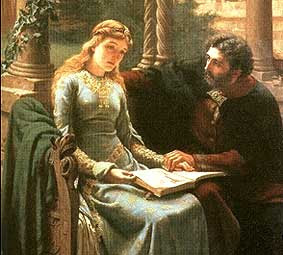
Growing Pains - The Maturity of Heloise and Abelard


[This entry was based off a series of medieval literature texts which can be found at this website: http://www.sacred-texts.com/chr/aah/index.htm]

Growing up in a small town like Millersville, there were few people to meet, fewer friends to play with, and no way to burn off excess childhood energy. I learned to read at a young age to fight boredom, and thanks to the local library I spent my evenings fighting pirates with Peter Pan or solving mysteries with Nancy Drew. The written word is a powerful addiction, and as I grew older I found that letters, texts, or emails from a handsome young man who shares your interests and has a sense of humor to match can be equally attractive. As we grow wiser in the ways of the world, we replace our fictional ideologies with those we find in reality, putting our childhood behind us but never forgetting what they inspired us to accomplish.

The letters between Abelard and Heloise depict a story of forbidden love, obsession, and knowledge. Just as Eve represents the temptation of knowledge, Heloise represents the temptation of a bright, beautiful, “modern” woman for her time. Abelard falls for her, as any self-respecting scholar might, since their wit and intellects are a perfect match. Ultimately, it is vanity and pride that bring the lovers to misery. It is apparent through their letters which express the strong feelings these two felt for one another that even though they were forcibly separated by a vengeful uncle and by vows to holy orders, Heloise and Abelard would remain connected through their memories of love.

It was not until recently, in 1998, that the University of Massachusetts moved to ban romantic relationships between students and teachers, which had become morally reprehensible and seen as a lecherous professor taking advantage of a less powerful female undergraduate student (Dank). As Abelard states in Historia Calamitatum, “I should not have been more smitten with wonder if he had entrusted a tender lamb to the care of a ravenous wolf […].” I find it ironic that Heloise’s uncle was paying him to seduce his niece.

The letters between Heloise and Abelard are heavy with philosophy, spirituality, and infatuation. They also show the growth of both literary figures. Abelard wished to marry Heloise in secret to protect his honor and reputation, and she would rather have been his mistress than his wife. To tie him down in marriage would be to hold him back, to prevent him from taking the opportunities that would present themselves to him in the future. It takes a mature, selfless woman to tell the man she is in love with “no, I will not marry you and keep you from doing what you love.” When Fulbert discovered that Abelard had convinced Heloise to intern herself in a convent, he assumed that Abelard was ridding himself of Heloise and his responsibilities to her. Fulbert’s punishment for Abelard was a ruthless mutilation and castration, an action that most overprotective father figures would admire. Unfortunately, after all the care both Heloise and Abelard took to protect their dignity, Abelard would never be able to walk confidently among his equals again. After becoming the abbess of a convent, Heloise no longer thought only of protecting Abelard, but of providing for the women in her care. Abelard states in his Apologia exactly how their relationship has grown: “Heloise, my sister, once so dear to me in the world, today even dearer to me in Jesus Christ […].” Once both were installed in their respective religious orders, each recognized the futility of their marriage, though they remained in love with one another, it was a new love sanctified by their love of God. The letters between Heloise and Abelard were never meant to published, they were intimate glimpses into the affair.

Never underestimate the power of a fictional character to encourage even the most depressed teenager to wake up every day, just as an attractive professor may find his 8 AM class filled each morning (Dr. Indiana Jones comes readily to mind). The pain of lost love stings deep and we never forget the feeling of caring more for one man than we cared for ourselves. Heloise and Abelard wrote from their hearts, and their eloquence reveals a common sadness of love gained and lost. It is the journey each young woman must make to bridge that gap between childhood and adulthood.


Bibliography

Dank, Barry M., and Klaus de Albuquerque. "Banning Sexual Asymmetry on Campus." Electronic Journal of Human Sexuality 1 (1998): n. pag. Electronic Journal of Human Sexuality. Web. 19 Feb. 2010.

"The Love Letters of Abelard and Heloise Index." Internet Sacred Text Archive Home. N.p., n.d. Web. 20 Feb. 2010. .

Thursday, June 2, 2011

Adventures in Awkwardland, Episode 17: Got a big job in the city.

I started my new job this past Tuesday. Growing up, working in the city, local government stuff. I didn't know what I was getting into when I accepted the position, but I've been having a pretty good time so far. The people I work with are quite nice even though I'm just temporarily filling in. But anyway, I see a lot of very odd things during the day. We're connected to the police department, so people come to pay their parking tickets, water bills, certain taxes, etc. with us. I never realized Lancaster was so... ... ... diverse?

Within the first hour and a half I met a 60 year old lesbian prostitute. That's right. I'm talking hotdogs and hallways, shriveled leather prostitute, but she actually turned down a solicitation offer from an equally work down looking man in our lobby.

Yesterday, I saw an asian with a blonde mullet. I'm talking full on anime hairstyles here, not just the typical early 90's redneck stuff. I think he was going for the Snake look, but if his hairdresser would just add some blue and he could have been Captain Planet.

Today was the weirdest. I wasn't in on the conversation until halfway through, but this guy was trying to get a parking permit for the car he drives. The car is in his mother's name, an automatic red flag when you're trying to get a parking permit, and he needed to show his license to prove he could even drive the car, and he'd like to pay by a check he wrote before he came in. So he goes into this long winded tirade about how he worked for the government on some top secret service missions studying the radioactivity of rocks during the early 90's and how his research was going to be published by National Geographic and what he found made a lot of top governmental people angry so they conspired to make him cause a car accident which resulted in his license being suspended for the past couple months and that's why he tried to pay a check dated June 2008. It's all George Bush's fault. Which one? Both. And how did they cause his traffic accident? Must have been the aliens.
Maybe next time he'll tell us he's a time traveler. I'd believe it easier.

The most awkward event is having men call me "honey" or "baby girl." I'm not used to it, and generally anyone I meet at my job is in trouble with their credit or bills. So when a motorcycle-riding viking with $200 in parking tickets and his water bill shut off asks for my number, I DO have standards and I know immediately to say "no thank you."

If you've started a new job as well, feel like sharing your awkward first day at work story, or have any awkward adventures to share, send them to: MyAwkwardAdventure@gmail.com

Tuesday, May 24, 2011

Ancient Greece in the News

There seems to be a plethora of treasures being unearthed in Europe and the mainland, but how many of these discoveries honestly make it to the museums? Obtaining rare antiquities is a difficult business, as any archaeologist will vouch, and interpreting the meanings behind those finds can take years.
On January 16, 2003, National Geographic published news that a group of researchers had found an ancient trading vessel at the bottom of the Black Sea, off the coast of Bulgaria. The ship is over 2.300 years old, and contained many clay jars and pots. The contents of these pots have answered many questions about the migration of goods across the world known by the Greeks; however they have also sparked many more.
The team of researchers analyzed the sediments around the shipwrecked vessel and discovered that the containers held remnants of catfish and olive oil. These foods would have made up much of the diet of the Greek army, which spread across the ancient world. Therefore, according to the data collected from the remains and also from radiocarbon dating and analysis, it would not be out of the question to assume that this ship was transporting goods from the Crimean peninsula back to Greece when it hit a spot of trouble and sank beneath the sea.
With this evidence, scientists and researchers have been able to determine that the Black Sea might have been a central location for trade rather than a secondary source. This shipwreck, combined with another Greek wreck found earlier in the Aegean Sea off the coast of Turkey, provides undeniable evidence that the Greeks had a far more spread out system of trade than previously recorded.

Bibliography:
Markey, Sean. “Ancient Greek Wreck Found in Black Sea.” National Geographic. http://news.nationalgeographic.com/news/2003/01/0110_030113_blacksea_2.html

Thursday, May 19, 2011

Adventures in Awkwardland, Episode 16: ID Card Got Your Tongue?

I heard this story while hanging out with a new group of friends, I don't know them very well but I intend to share this story anyway. I very nearly snorted Sam Adams out my nose, therefore, this tale deserves to be told.

Josh works at a local hospital here in town, I'm honestly not sure if he's a technician or a student. Not really important, he was in charge of taking a patient's IV statistics that night. The woman was on loan from the psych ward, she has bipolar disorder and one or two other mental illnesses which leave her uncensored and able to speak her mind. However she was also having heart troubles, and therefore needed to be in a special care unit for the night. As Josh was going over her charts, the woman began to flirt with him. She's about 60 years old, married (so she says), and veeerrry adventurous. Josh does his best to laugh off her advances, he's a good looking guy and used to joking with his patients.

Now, Josh needed to insert the IV in this woman's arm, and leaned close to her bed. While he's busy working on her arm, she grabs the ID card attached by a string to his pocket and shoves it in her mouth. The whole card. I imagine she looks like a cat caught swallowing a mouse. Since Josh is still working in the IV drip, there's not much he can do about the card. The other technicians in the room start to giggle and Josh tries his best not to lose it in front of the woman. When he's finished, he grabs the string in front of the lady's mouth and pulls his ID card. You better bet he sterilized the living crap out of that thing before reattaching it to his shirt.

The worst part? Not only does the entire hospital know the tale, but Josh is the only IV technician assigned to this woman's bed.

Got an Awkward Adventure to share? Send them to: MyAwkwardAdventure@gmail.com

Tuesday, May 17, 2011

The Legend of Achilles

According to myth, Achilles' mother Thetis was a sea nymph, and therefore immortal. His father Peleus, however, was not immortal, which meant that any of Thetis' children would be only semi-divine and therefore wholly susceptible to pain, mortality, and general fatalistic death.

Thetis was understandably not very pleased with the idea of her children dying, and proceeded to attempt a “Make My Children Immortal” campaign using a “Do It Yourself” home kit. This involved shoving her children into fires, dunking them in boiling tar, dropping them down dangerous rapids and lightly broiling them in casserole dishes with diced onions and lots of oil. However, Achilles was saved from this tasty fate by his father who managed to stop Thetis from charbroiling his last son.

In disgust, Thetis tried the next best option by dipping Achilles into the River Styx, which would make him immune to all axes, arrows and anything spiky enough to puncture skin. However, she held on to his ankle to do so and as a result, Achilles' heel was left untouched. Thus his dodgy heel.

No one knows why Thetis forgot, or why she didn't just dip him in holding one heel and then hold the other one so the first heel could get a dunking. But it can be assumed she certainly kicked herself after Achilles was subsequently killed to death by means of said heel being penetrated with a poisoned arrow during his daring raid in the battle at Troy.

Sunday, May 15, 2011

Reflections on Lysistrata

Lysistrata is a delightful anti-war skit written by Aristophanes in 411 B.C. It was exceptionally creative for the time, written when the view towards women was bleak and gender roles ruled the communities. Greek men were more likely to go off to war than to ever acknowledge a woman with a mind of her own.

Women were not respected as members of the community, often ignored, and the general male population assumed they did not have the mental capacity to understand matters of state. However, Lysistrata threw them for a loop when she organized widespread abstinence throughout Athens and barricaded access to the city funds in an attempt to stop the war with Sparta. If only life were that simple. The women felt very bitter and resentful to have lost so many husbands, brothers, sons, and potential lovers to the constant carnage. Lysistrata’s plan worked on a very small scale, spreading to Sparta and eventually frustrating the men on both sides into submission.

At the onset of the war with Iraq, a campaign against such action was launched called The Lysistrata Project. The Project, guided by the teachings of Gandhi, seeks innovative solutions to bring peace to the world. The women in charge of the site are, as would be expected, feminists, and will most probably be using gender bias to provoke interest in their cause. This is unfortunate, that such a goodwill organization must play the gender card in modern times. For the original Lysistrata, in a time where women were not seen as equals, a revolutionary idea to bring peace would have generated much attention. Today, gender based committees are more mainstream and passed over as just another outspoken activist group.

And so, in the here and now, women have achieved equality, but what good has it done us? Today, we would never be able to achieve that which Lysistrata initiated, we are too disorganized, too easily passed off as radical feminists, and too unwilling to push the boundaries on acceptable behavior. And, let's face it, as a culture we are too addicted to sex. However, if more women would read the literature of Aristophanes and accept the beliefs of Lysistrata, we may very well see a rise in the influence of women over issues of war and peace.

Thursday, May 12, 2011

The Evolution of Athens, abridged

In the seventh century B.C. the governmental system of Athens began a radical new evolution. The monarchist autocracy was replaced by an aristocratic oligarchy, a government ruled by a few of the best and the brightest of the upper class rather than by a single monarch. This tookquite some time for the Athenians to adjust to; however in the end, it was best for the country. The aristocrats of Athens wanted to control the destiny, power, and new wealth of their state. The population was growing fast, spreading across the Mediterranean Sea. Their culture developed into a powerful force, adjusting to incorporate the cultures of the nations conquered by the Athenians while retaining their individual style.

Athens was developing into a powerful state and accumulating a great deal of wealth. Their trade and commerce was booming, aided in part by rich farmland and productive workers, but also by their new status as a sea power. The newly rising wealthy class wanted to share the power of the monarchs of Athens and threatened to stage a coup d’etat. They were willing to support a tyrant who supported their interests so long as they had a say in the government. A rebellion ensued, and Draco, the ruler in 621, imposed harsh penalties for wrongdoers. Under Draconian law, criminals of any sort were put to death. Citizens fell into debtor slavery. The laws were interpreted in such a way to cause extreme strife and hardships. Citizens felt enfranchised as they earned wealth, and joined the emerging wealthy class. This promise of wealth motivated citizens to work harder than slaves, so as to earn a place in the world even without the distinction as nobility.

When Solon came to power as a liberal aristocrat in 594 B.C., his policy attempted to avert tyranny at all costs. He is credited as having laid the foundations for Athenian democracy. Many reforms were issued so that Solon would gain the popularity and support of the Athenian citizens. His first act changed the Draconian law code to a friendlier system. All debts were cancelled, and debtor slaves were freed. Under Solon, commerce livened as citizenship was granted to foreign artisans to create an explosion of culture and promote trade and commerce.

Solon also instituted a salary for public offices so that more citizens would run for a position in the public office. State office was open to the wealthiest citizens, regardless of birth. The upper two classes of citizens were able to participate in the Areopagus, a judicial counsel originally created to try homicide cases. Three Archons were elected to lead specific areas of life every ten years; however Solon briefly increased that number to ten. The ecclesia consisted of all male citizens over the age of 18 who were wealthy enough to be able to spend their lives working for the ecclesia, and nominated magisters. Solon also instituted the “boule,” a counsel of 400 men representing the four tribes of Athens. All male citizens over the age of 18 were able to participate in the popular court where everyone could vote, and class was determined by the agricultural production. Unfortunately, there was not enough land in Athens for this system to work to the maximum effect, so others, such as merchants or artisans, became angry when they earned wealth through other ways and still could not participate in the counsels. The birth of capitalism through private wealth and power fell upon hard times.

After Solon, tyrants such as Peisistratus and his son Hippias gained power. Peisistratus seized the power in the Acropolis after the death of Solon, thus entering the history books as a tyrant. He was driven out twice, but returned en masse with his supportive army and was welcomed by the Athenians who thought he has the blessing of Athena. Tyrant that he was, Peisistratus is credited as having created the first welfare state. His son, Hippias, became a cruel and harsh tyrant. With the help of the Spartans, he was overthrown. However, Sparta came to fear Athens’ drift towards democracy, and with the help of Persia, attempted to reinstate Hippias, but was unsuccessful.

A new leader, Kleisthenes, led between 508 and 501 B.C. He needed a new way to enfranchise his citizens due to public disputes over the land issue, and decided to re-zone the Athenian polis. He created ten new tribes to replace the traditional four, and seventeen demes, or subdivisions of the polis. Each deme had a socio-economic restructuring, and was required to vote for the best interests as a whole. In addition, Kleisthenes adjusted the rules of the boule so that instead of a counsel of 400, it became a counsel of 500, with fifty members from each of the ten tribes of Athens.

In 461 B.C., Pericles assumed power, and helped to usher in the Golden Age of Greece. He severely limited the power of the Areopagus, controlled by the aristocratic oligarchy, and replaced it with ten Strategoi, or general directors, who were elected by all male citizens over the age of 18 on a yearly basis. State offices offered a paid income, so that members of the lower classes would be more inclined to run for office. The General Assembly might pass all laws especially when in reference to foreign policy, and could even choose whether to hold a war or to remain neutral. The lower classes usually felt favorable towards war, because it meant, when won, an extra boost in the economy and in the national bank.

Under Pericles, the Athenian and Greek culture in general flowered and gained a sense of posterity. Pericles wanted to make Athens a city of value for future generations, and commissioned the Parthenon to be built in honor of Athena. Athens became an intellectual center of the world, as philosophers came together to understand nature and the development of reason.

Pericles led Athens from the end of the Persian War through most of the Peloponnesian Wars. An attack from Persia always intimidated the Greeks, even though they had deflected Persia in the past. There was no guarantee about the future. Therefore, the Delian League was created as a defense field, much like NATO today. Their goal was to unify Greece and to avenge the wrongs done by Persia. However, when Sparta and Persia joined forces, Athens used this betrayal to call together the Delian League to unite and become more powerful. Athens became a shining city, however democracy still frightened their enemies. Democracy was chaotic, and many did not like this government.

The war with Persia threatened western civilization with complete annihilation. Sparta and Athens overcame their differences and years of enmity and fought together. The Spartan women were able to run their state as independent members of their society, and the Spartan homeland was left untouched. Athens, however, was all but destroyed. A power shift occurred in Athens from the aristocratic oligarchy as the lower class warriors in the battle of Salamis wanted enfranchisement, like the rest of the country had the opportunity to achieve. All of these factors led to the eventual rise of Pericles, and the Golden Age of Greece.

The Greeks preferred democracy to the tyranny that oppressed them in the past, and were willing to fight many a battle to retain their freedoms. As master of its own fate, Athens connected economic and political opportunities for all, and reaped the benefits of their hard work and toil.

Wednesday, May 11, 2011

EUREKA!!

After much technical difficulty the past few days, I have finally set up my desktop computer!!! Earlier in the week I fried my laptop (R.I.P. Brinkley, 2007-1011) by clogging the fan with pet hair and whatever else floats in between small spaces in techy gadgets. We've been debating whether the cost to replace the fan on a four year old laptop is a good investment or if we should cave in and buy a new laptop. After all, for a Dell Vostro 1000, y'all better believe that little bugger served me like a champ as I graduated high school AND college without even upgrading the video card. Then, brilliantly, I remembered I already had my desktop in storage (i.e. the basement) and did my best to set up the wires correctly. Now I have a desk floating in the middle of my already cramped room, but whatever. I have internet access.

Anyway, I have a whole slew of articles to post in the next few days. Bear with me a bit here, they're mostly educational and almost all related to the ancient and medieval research I have done. I hope you enjoy them.

Tuesday, May 10, 2011

Just because.

“Here’s to the crazy ones, the misfits, the rebels, the troublemakers, the round pegs in the square holes… the ones who see things differently — they’re not fond of rules… You can quote them, disagree with them, glorify or vilify them, but the only thing you can’t do is ignore them because they change things… they push the human race forward, and while some may see them as the crazy ones, we see genius, because the ones who are crazy enough to think that they can change the world, are the ones who do.”

- Jack Kerouac

I'll get back to updating this more regularly soon enough. Things got crazy the past few weeks, and once I'm out of this slump I'll bring back some Awkwardland, maybe some of these art projects, and as usual the sarcasm. There's some things I'd really like to write but now is not the time. Don't stray too far, this too shall pass.


Wednesday, April 27, 2011

For our next invention, the Cupcake Bowl.

All this finger-pointing about who “stole” the cookie from the cookie jar—this song makes me so mad. Guys, it’s a cookie jar. Putting cookies in a cookie jar is a way of telling people, “Hey, guys, I just made a batch of cookies and put the extras in the cookie jar. You’re more than welcome to have some.” That’s why it’s a jar—so that people can reach in from the top and select a cookie at their convenience. But now all of a sudden this is “stealing.” That’s like saying, “Alright, who took some of my goddamned mints from my mint bowl! I placed this bowl of mints in an easily-accessible spot right on the table next to the couch, hoping to snack on them from time to time, yet you jackasses keep eating them!” I’ll stop stealing your precious cookies the minute you stop putting them in a fucking jar and giving them away.

Sunday, April 24, 2011

This could be fun, just bear with me for a moment.

I have developed a new technique for when you’re trying to attract a person’s attention at the bar. Most people order their prospective mate a drink, which is fine—if you want to play that tired little game of cat and mouse. If however you actually want to leave an impression, consider having your waitress send them over something to snack on. From across the bar you will be treated to the following scene: there will be a confused conversation between the waitress and the girl you fancy, followed by the waitress gesturing toward your table. Signal with your index finger or a thumbs up that the food is indeed for her to enjoy.

For the rest of the night the girl will be eyeing you—with a look of trepidation, maybe, but at least now she knows you’re not just kidding around. Not every food item works equally well, so if it’s available on the menu, play it safe and order her chili cheese fries. Regular cheese fries will do in a pinch, but you’re really not going to get anywhere without the chili. There is something special about the way people eat chili cheese fries when they are bewildered out of their mind. The best food to order them is a large bowl of soup, especially when there’s an entire group of girls. Instruct your waitress to place the soup in the center of their table with a single spoon. This doubles as a fun gambling game to play with your friends: Who will take the spoon and begin eating the soup? Will they ask the waitress for more spoons? Whatever they decide to do, I’m pretty sure that this is considered checkmate. You may now approach the girl of your choice and receive your make out session.

Tuesday, April 19, 2011

Screw you, Anti-Aging Fascists, I'm going out with style.

When I become elderly, I’m going to be one of the top elderly people around. That’s because I’ve carefully plotted out which hobbies and behaviors I’m going to adopt, what clothes I’m going to wear, and even what crazy unintelligible things I’m going to mutter. When most people become elderly, they don’t have any kind of game plan. They’ve spent decades preparing for retirement financially, but they’re incapable of assuming a proper elderly disposition. I’m going to avoid this trap by adhering to a very specific chronology:

Age 66: It’s time to start bird watching. If I so much as think I hear a tweet, I’m going to drop what I’m doing and find the corresponding bird, and then I’m going to stand around watching him until dark. I’ll even have a little notebook to keep track of the birds I’ve seen, a list which is going to become gradually more improbable as I descend into senility. I will claim to have spotted extremely rare birds, then birds which are extinct, then fictional species from my favorite movies, then some dinosaurs, and then finally varieties of birds which exist only in my imagination.

Age 70: On my 70th birthday, I’m going to take up bridge in a big way. It’s a complex game, but what the other elderly people around me won’t realize is that I’ll have been secretly reading up on bridge since I was like 40. I’m going to waltz over to the card table and me and my partner are going to absolutely demolish everyone while employing an insane amount of trash talk.

Age 78: You won’t believe how ornate my cane is going to be. It’ll be bejeweled, obviously, and shaped like a dragon’s head at the handle. But where my cane will really stand out will be its rosewood body, which is going to be carved with amazing battle scenes and secret messages and other cryptic flourishes. There’s also going to be a switchblade that flips out from the bottom which I’ll use to stab my detractors.

Age 82: Now it’s time to begin openly cheating at bridge. Actually, I’m going to begin cheating at everything, including board games, bocce ball, dominos, and even jigsaw puzzles. The best elderly people have elements of connivery in their personalties, because to the elderly, everything is a matter of life and death. Young people don’t understand that society’s unspoken rules don’t apply to elderly people, and neither do traffic ordinances or public intoxication laws.

Age 87: I will officially make the switch from giving out candy on Halloween to giving out handfuls of pennies. Some elderly people make the mistake of giving out pennies when they’re 84 or 85, but I think that’s a bit early. At 87, it’s impossible for others to question this sort of bizarre, erratic behavior.

Age 93: As my mobility becomes limited, I’m going to begin collecting postage stamps—massive shitloads of stamps, probably the biggest collection of all time. What’s ironic is that although the stamp is a symbol of communication, I’m going to have begun secluding myself in the attic of my house (which will be filled to the ceiling with useless and broken appliances). The binoculars from my bird watching days are now going to be used to spy on my neighbors, who will have begun circulating mythical legends about my personal history—legends I’ve been secretly disseminating over the years. Gradually I will become a pariah, spoken of only in hushed tones, feared by children and adults alike—gradually I will become one of the greatest elderly people of all time.

Tuesday, April 12, 2011

Speaking of Computers...

There’re a lot of useless keys on a standard PC keyboard, but only the insert key has the power to fuck with your work. I would rather the insert key be replaced with a button that gives you a mild electrical shock. Prior to pointing devices, the insert key might have had some utility, but now it’s just a trick button. What it does is it transforms your keyboard into a living nightmare in which everything you type replaces the text in front of it, as if all that other text in your document was just hanging around for decoration.

The only scenario this would be useful is if you wanted to get rid of the proceeding text of your document, but only in a quantity of characters that was exactly equal to your newly-inserted text. What kind of asshole would make such an edit? “Man, I really need to delete the thirteen characters to the immediate right of my text cursor, and I also need to insert a word that’s exactly eleven characters long, leaving two extra characters for spaces. Time for my trusty insert key!” How about you insert a bullet into your head?

Meanwhile, the insert key is located right next to backspace, which is for people who edit text in an educated fashion. So I’m constantly hitting the insert key on accident, and there’s no way to tell that you’ve toggled on overtype mode until you notice that your new text is eating the shit out of your old text. Maybe there’s a way to disable this—maybe there is. Maybe there’s also a way to pry the button off with a carving knife. But I would like to know if any sort of person needs their insert key, because perhaps I speak out of ignorance. Do coders use overtype mode? Has anybody in the last twenty years hit this key on purpose? Or should I organize a protest?